 Pat Parseghian Pat Parseghian
Follow my latest cycling adventures and miscellaneous musings in my blog.
In the summer of 1996, I left my native New Jersey behind, moving to sunny California, where I had a downhill adventure on a pair of inline skates and finally experienced my first earthquake.
From 1990-2013, I was a volunteer with Learning Ally (formerly known as Recording for the Blind and Dyslexic), where I recorded technical material from books in computer science, psychology, and related fields.
When I joined Google in 2007 I was reunited with many of my best colleagues, from every job I'd had—and then I gained so many more. I'd found my “forever home” (for 16 years); the challenges were exciting and the scale ... beyond compare.
At Transmeta, I created the Transmeta Lab for Compatibility (TLC), the Quality Assurance organization that ensured that the Crusoe™ microprocessor would run any device or piece of x86 software you might feed it.
I contributed to early editions of Mark Sobell's A Practical Guide to . . . books, including A Practical Guide to LINUX.
I managed XUNET 2, a cross-country ATM network that linked AT&T Bell Laboratories with several universities and government labs. XUNET 2 provided the infrastructure for the BLANCA testbed. I was also involved with the Plexus Project, providing 100 Mbps fiber optic network connections for two public schools in New Jersey.
Before that, I managed the Computing Facilities for the Dept. of Computer Science at Princeton University.
Improbably enough, my Erdős number is 4. You might enjoy Paul Hoffman's book The Man Who Loved Only Numbers: The Story of Paul Erdős and the Search for Mathematical Truth.
Some citations of my work from a Computer Science Bibliography Collection.
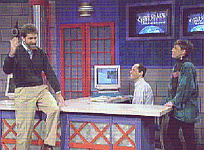 On
April 27, 1994 I did a "tour" of the Internet on live
television as part of a six-hour science marathon, Live
from AT&T Bell Labs! (What was I thinking?!) The Indy workstation's
window manager had a nasty habit of crashing when the color map
filled up, as it did ten minutes before we went on the air. Luckily,
we got through our segment unscathed. At the same time, I broadcast
the entire show over the Internet to a world-wide MBone (Multi-cast Backbone)
audience, much to the fascination of the professional TV crew.
On
April 27, 1994 I did a "tour" of the Internet on live
television as part of a six-hour science marathon, Live
from AT&T Bell Labs! (What was I thinking?!) The Indy workstation's
window manager had a nasty habit of crashing when the color map
filled up, as it did ten minutes before we went on the air. Luckily,
we got through our segment unscathed. At the same time, I broadcast
the entire show over the Internet to a world-wide MBone (Multi-cast Backbone)
audience, much to the fascination of the professional TV crew.
How many of my early favorite Web sites, collected mostly during the summer of 1994, are still around?
On Saturday, April 8, 1995 I gave two presentations on “Cruising the Information Superhighway” in the Murray Hill, NJ auditorium, as part of the AT&T Bell Labs World of Science Seminar series. The World of Science series ran from 1984 through 2001, with lectures that were open to the general public, geared toward high school students and teachers.
My tour on the lecture circuit included Kauai in January, Manila in April, Memphis in May, Caracas in November, and many places in between. Here are some blurbs about the talks I delivered in Washington, DC and Wilmington, Delaware.
In 2000, I completed a two-year term on the Board of Directors of the USENIX Association.
In 1994, I completed a two-year term on SAGE's first elected board of directors. SAGE (the System Administrators' Guild, subsequently known as LISA) was the first special technical group sponsored by the USENIX Association.

|
The MacNeil/Lehrer News Hour, broadcast July 7, 1995. |

|
Appearing in “award-winning” interactive CD-ROM Understanding the Information Superhighway: Envisioneering with Technologies |

|
Representing
Telecommunications on the CD-ROM Changing Channels . . . Careers of the 21st Century |
| Popular Mechanics, Inside Bell Labs, August 1994 |